

Is a Travel Advisor Worth It? (A True Cost vs Value Breakdown)
An Honest, In‑Depth Guide for Today’s Travelers
If you’ve ever planned a trip that started out exciting and slowly turned into a full‑time job, you’re not alone. What begins as a dreamy idea: Italy in the fall, a Caribbean escape, a bucket‑list safari, often ends with dozens of browser tabs, conflicting reviews, half‑formed itineraries, and a quiet sense of doubt about whether you’re actually booking the right things.
Which is exactly why so many travelers eventually ask the same question:
Is a travel advisor worth it?
In an era where you can book flights on your phone, compare hotels in seconds, and binge travel content on TikTok, hiring a travel advisor can feel unnecessary, or even indulgent. Isn’t travel planning something we’re supposed to be able to do ourselves now?
The honest answer is nuanced. A travel advisor isn’t always necessary. But for the right trip, at the right time, for the right traveler, working with a professional can completely change not just how your trip is planned, but how it actually feels to experience it.
This guide breaks down what travel advisors really do, when they’re genuinely worth the investment, when you can skip one without guilt, and how to decide what makes sense for your travel style. No pressure. No outdated stereotypes. Just a realistic look at modern travel planning.

First, What Does a Travel Advisor Actually Do?

Let’s clear up a common misconception: a modern travel advisor is not simply someone who books flights and hotels for people who don’t know how to use the internet.
The role has evolved dramatically over the past decade. Think of it more as professional tailored guidance.
A travel advisor is a professional who designs, manages, and supports travel experiences, often from the earliest idea stage through your return home. Depending on the service level, that can include everything from destination selection and itinerary design to booking, logistics, on‑trip support, and troubleshooting when things don’t go according to plan.
At its best, travel advising sits at the intersection of logistics, strategy, industry insight, and personal customization. It’s less about transactions and bookings and more about translation. A good advisor turns endless information into a trip that actually works in real life. Because sometimes, no matter how thorough you know your plan is, you don’t know what you don’t know, until of course you get to your destination and find yourself confused over how exactly the public transportation system works.
Travel Advisor vs. Travel Agent: Why the Distinction Matters


You’ll still hear the terms travel agent and travel advisor used interchangeably, but they reflect different approaches.
Traditional travel agents historically focused on selling pre‑packaged trips, cruises, or flights from a fixed set of suppliers. The goal was efficiency and volume, because meager commissions add up when you sell at volume.
Modern travel advisors, by contrast, tend to:
- Work with custom itineraries rather than templates
- Specialize in certain destinations or travel styles
- Act as long‑term resources rather than one‑time bookers
- Advocate for clients before, during, and sometimes after travel
- Spend time developing a personal understanding of their client and planning tailored experiences accordingly
The shift mirrors how people travel today, with intention. Travelers aren’t just buying transportation and lodging, they’re designing experiences. And that’s where advisors add real value.
Why This Question Comes Up So Often Now
The reason travelers question whether advisors are worth it isn’t because advisors have become less useful; it’s because the evolution of technology has made travel planning accessible, and dare I say easy. That is until the droves of information became overwhelming, and the sources questionable.

You can research almost anything online, and the introduction of AI has only made the process even more seamless. But, more information doesn’t necessarily mean better information, or better decisions. In fact, it often leads to:
- Hours of scrolling and searching, waiting for the next best thing on the other side of that click
- Decision fatigue
- Second‑guessing
- Misinformation from an AI search that leads to logistical nightmares while traveling
- Overpacked itineraries that exhaust rather than decompress
- Mismatched expectations based on unrealistic or AI generated TikTok shorts
Online tools are excellent at showing you what exists. They’re far less helpful at showing you what makes sense for you.
A travel advisor bridges that gap.
What Travel Advisors Provide That Google, AI and TikTok Can’t



1. Strategic Planning, Not Just Research
Google can tell you the “top 10 things to do.” It can’t tell you which three are actually worth your limited time, or which ones quietly don’t live up to the hype.
A travel advisor looks at your trip holistically:
- How long you really need in each place
- Which stops pair well together
- Where travel time will eat into your experience
- What to prioritize, and what to skip
- Where to incorporate rest days
This kind of planning prevents the most common travel regret: trying to do too much and enjoying too little.
2. Personalization That Goes Beyond Preferences
Most booking platforms personalize based on price and popularity. Travel advisors personalize based on people.
That means factoring in:
- Your pace of travel
- Your tolerance for early mornings or long transfers
- Whether you prefer guided structure or independent exploration
- How important food, comfort, adventure, or downtime are to you
Two travelers can visit the same destination and need completely different itineraries. A good advisor recognizes that immediately.
3. Real‑World Knowledge (Not Just Reviews)
Online reviews are helpful, but they’re also inconsistent, subjective, and often outdated.
Travel advisors rely on:
- Firsthand experience
- Trusted supplier feedback
- Client reports
- Industry updates that never make it into reviews
This helps avoid common pitfalls like booking hotels in inconvenient neighborhoods, choosing experiences that look great online but disappoint in reality, or visiting destinations at the wrong time of year.
4. Access, Advocacy, and Added Value
One of the most tangible benefits of working with a travel advisor is access, to both perks and people.
Through preferred partnerships and professional networks, advisors may secure:
- Room upgrades
- Daily breakfast credits
- Resort or shipboard credits
- Early check‑in and late check‑out
- Priority waitlists or amenities
- VIP experiences
Just as important is advocacy. If something goes wrong, you’re not navigating customer service alone. Your advisor is the one making calls, sending emails, and pushing for solutions.
When a Travel Advisor Is Absolutely Worth It

Complex or Multi‑Stop International Travel
Once a trip involves multiple destinations, transportation types, or countries, complexity rises quickly. Advisors help ensure connections make sense, timing is realistic, and logistics don’t quietly undermine your experience.
Special Occasion Trips
Honeymoons, anniversaries, milestone birthdays, and once‑in‑a‑lifetime trips carry emotional weight. Most travelers don’t want to leave those experiences to chance, or regret not planning them better.
Group Travel
Coordinating multiple schedules, budgets, room preferences, and personalities while managing deposits, deadlines, and shared logistics can quickly turn into a stress test. A travel advisor acts as a central point of coordination, keeping everyone aligned while removing the emotional labor from the organizer.
Luxury, Experiential, or Adventure Travel
Luxury travel isn’t just about higher price points; it’s about smooth execution. Adventure and niche travel, like scuba diving, safaris, or expedition cruising, requires specialized knowledge and vetted operators. This is where advisors truly earn their keep.
Limited Time or Mental Bandwidth
Sometimes the deciding factor isn’t budget, it’s bandwidth. If planning feels like another job rather than something you enjoy, outsourcing it can be one of the best travel decisions you make.
When You Might Not Need a Travel Advisor

Not every trip requires professional planning, and that’s okay.
You may not need a travel advisor if:
- You’re booking a simple domestic getaway
- You enjoy researching and planning every detail yourself
- You’re returning to a destination you already know well
- You value spontaneity over structure
A good advisor will tell you this honestly, and may even suggest a lighter‑touch planning option instead of full service.
Understanding Fees and Value

Many true travel advisors charge planning or service fees, especially for custom itineraries. Others rely primarily on supplier commissions, these are typically the agents. Most use a hybrid model.
What’s important isn’t how they’re paid, it’s whether the value aligns with what you’re receiving.
Planning fees compensate for:
- Time and expertise
- Custom research and itinerary design
- Industry insight and supplier vetting
- Ongoing support and problem‑solving
Viewed through that lens, a travel advisor functions much like any other professional consultant, and any worth while consultant will tell you time and expertise = money. You wouldn’t expect a professional consultant to work for free, and you shouldn’t expect your travel advisor to do so either.
How to Decide If a Travel Advisor Is Right for You

Ask yourself:
- What is my own time worth?
- Do I want to spend my time searching and planning, or enjoying anticipation?
- Is this an expensive or complicated trip, and will I regret getting wrong?
- Would expert guidance reduce stress?
- Do I value having support if plans change?
If those questions resonate, working with an advisor is likely worth it.
Why I Built a Tiered Service Structure for Dear Destination Travel

I created Dear Destination Travel because travelers don’t all need the same level of help.
Some want full concierge planning: booking, management, and support from start to finish. Others want a beautifully designed, expert‑level itinerary they can book themselves with confidence. Still, others value advice gained through reading my blog.
I prefer the title of Travel Consultant, because that is what I do on varying levels. I offer sound and experience driven advice, recommendations and support through both custom itinerary planning and full travel advising services, so travelers can choose what actually fits their needs, not what someone tells them they should want.
Travel Advisor vs. Itinerary Planner
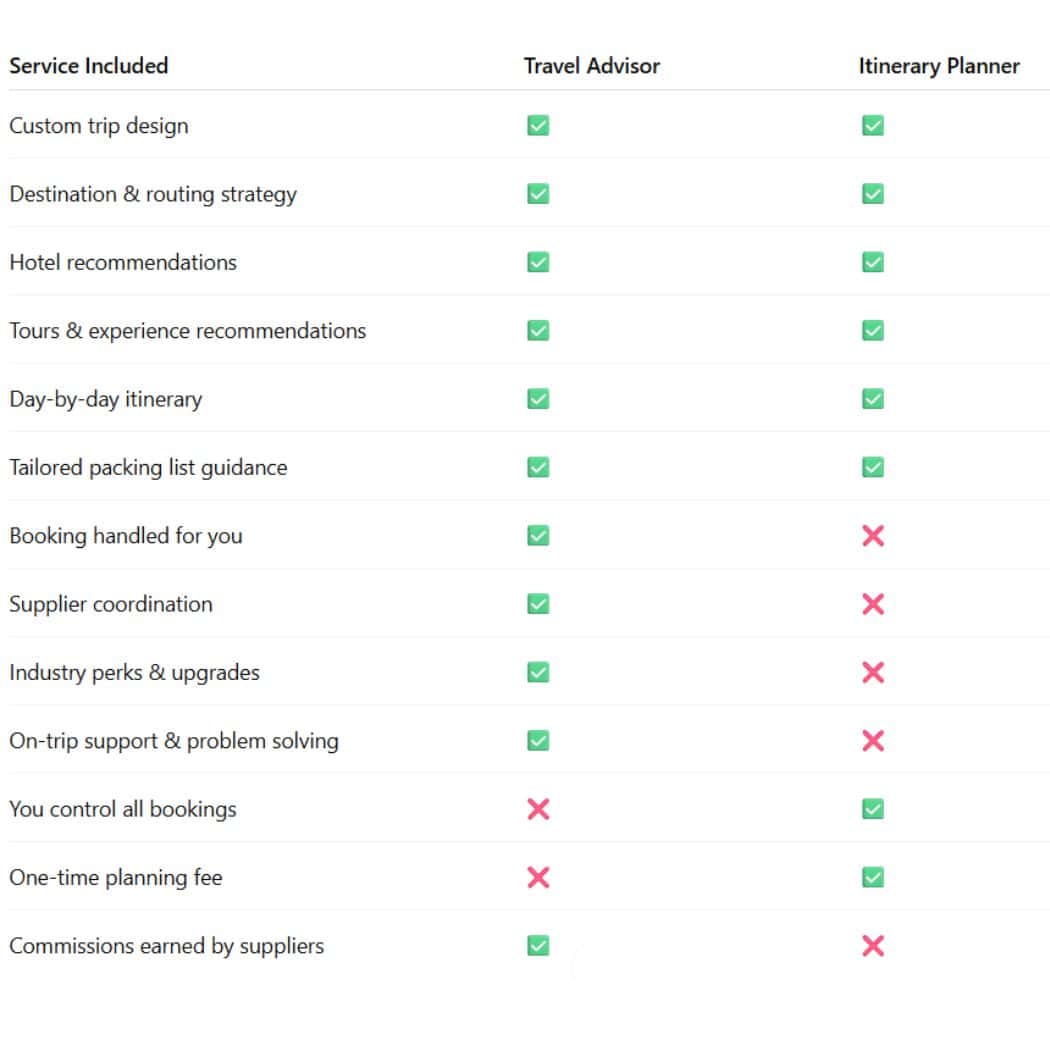
Travel Advisor = full-service booking, management, and support
Itinerary Planner = expert strategy and structure, with total booking control
Final Thoughts: Is a Travel Advisor Worth It?

A travel advisor isn’t necessary for every trip. But for the trips that matter most, where time, money, and experience all intersect, the right advisor can elevate travel from stressful to seamless.
If you value your time, want clarity instead of overwhelm, and care deeply about how your trip unfolds, then yes, a travel advisor is absolutely worth it.
Because the best trips aren’t just booked. They’re thoughtfully designed.