My Bucket List Egyptian Experience: A Beginners Guide to Traveling Egypt
In February 2020, just weeks before the world shut down, I embarked on one of the most memorable trips of my life to the land of Pharaohs: Egypt. This was a bucket-list journey filled with golden temples, legendary tombs, and surreal experiences along the Nile. Our itinerary, curated by Blue Sky Travel, took us from bustling Cairo to the serene waters of Luxor and Aswan — a luxurious experience that felt like stepping back in time thousands of years.
Below, I’ll share our day-by-day journey, including personal highlights, insider tips, and a few lessons learned along the way. If Egypt is on your radar, consider this both a travel diary and a guide for making the most of your own adventure.

🏺 Egypt is a once-in-a-lifetime adventure that rewards both structure and spontaneity. If you are planning your own Egyptian adventure, I would be happy to assist with your itinerary. Contact me for more information.
Day 1: Arrival in Cairo
We did get off to a bit of a rough start as we arrived late at night at Cairo International Airport. Unfortunately, Cairo had been inundated with more rainfall that evening than it had seen all year and the roads to the airport were flooded and impassable for hours. This left a group of us travel-weary travelers to sit in the airport from about 11 PM to 2PM waiting for our transport van to arrive and take us to our hotel. Eventually, they did arrive, and we were warmly greeted by our Blue Sky representative and transferred to our beautiful and comfortable hotel, the Hilton Zamalek. After a long day of travel, nothing felt better than settling into the fine linens of our cushy hotel beds as we anticipated the days ahead.
Pro Tip: When booking an all-inclusive small group tour as we did through Blue Sky, know that you can request flights that do not arrive in the middle of the night. It may end up costing you a little more, but I think it is well worth the extra money to enjoy the evening in Cairo and get a good night’s rest before the following days activities. I know ours was a special case that could not be avoided, but we ended up only getting about 3-hours of sleep that first night, which made out busy day 2 a bit of a struggle.
Day 2: The Great Pyramids, the Sphinx, Saqqara, and Memphis
Our Egyptian adventure began bright and early with a 7:00 AM wake-up call and a chipper tour guide waiting for us on a comfortable, air-conditioned bus. Her name was Sahar, a Cairo-based Egyptologist who would bring the city’s ancient wonders to life for us. And we had a jam-packed day ahead.
Great Pyramids of Giza and the Sphinx
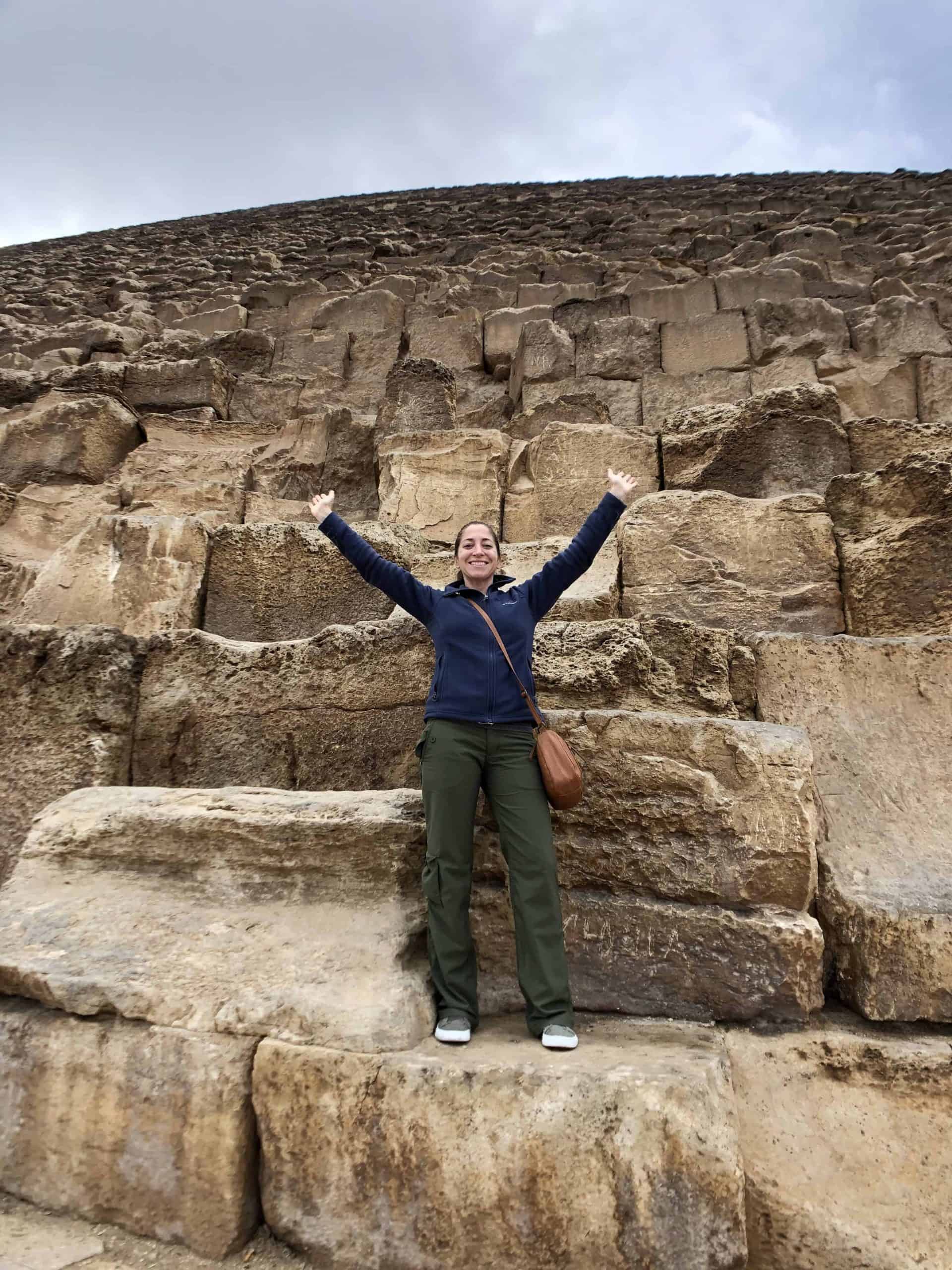
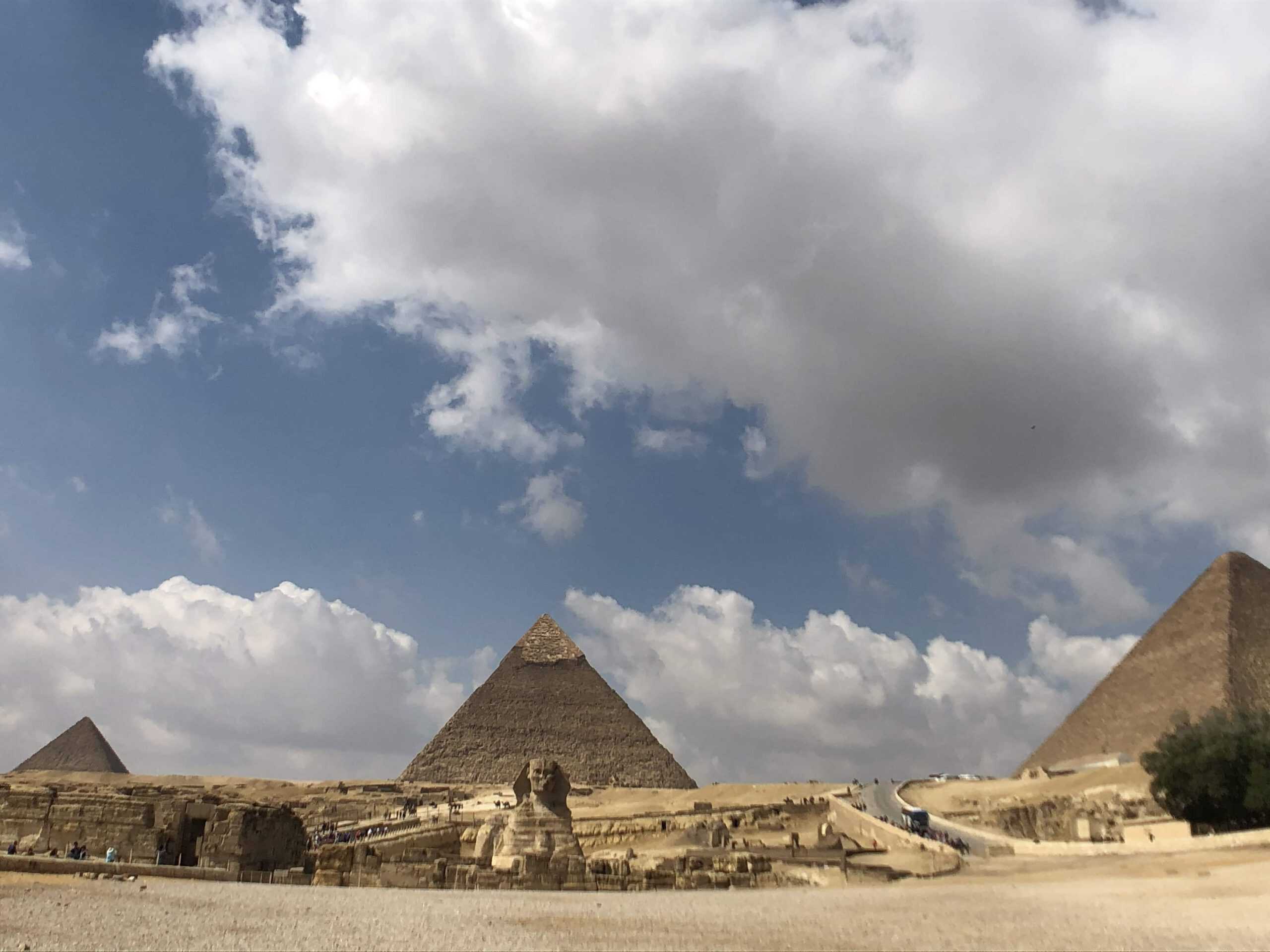
To start the day in true Egyptian style, we went straight to the Great Pyramids of Giza and the Sphinx. Nothing — not photos, videos, or years of reading about them — can prepare you for the sheer size of these wonders. We got up close, even climbing onto a few of the massive blocks near the base. Standing there, dwarfed by stone that had been placed more than 4,500 years ago without the help of modern machinery, was a humbling reminder of the brilliance and ambition of ancient engineers.
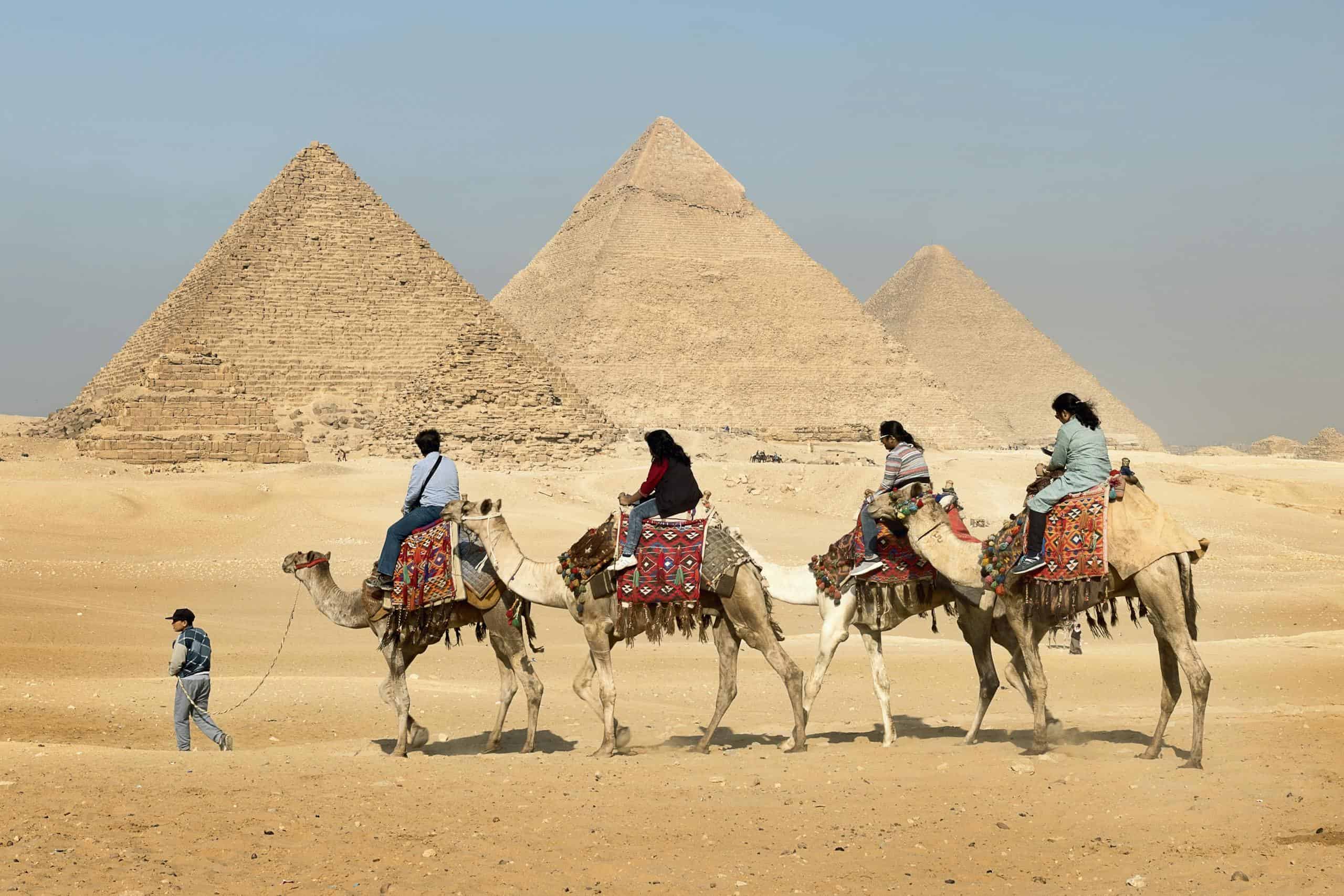
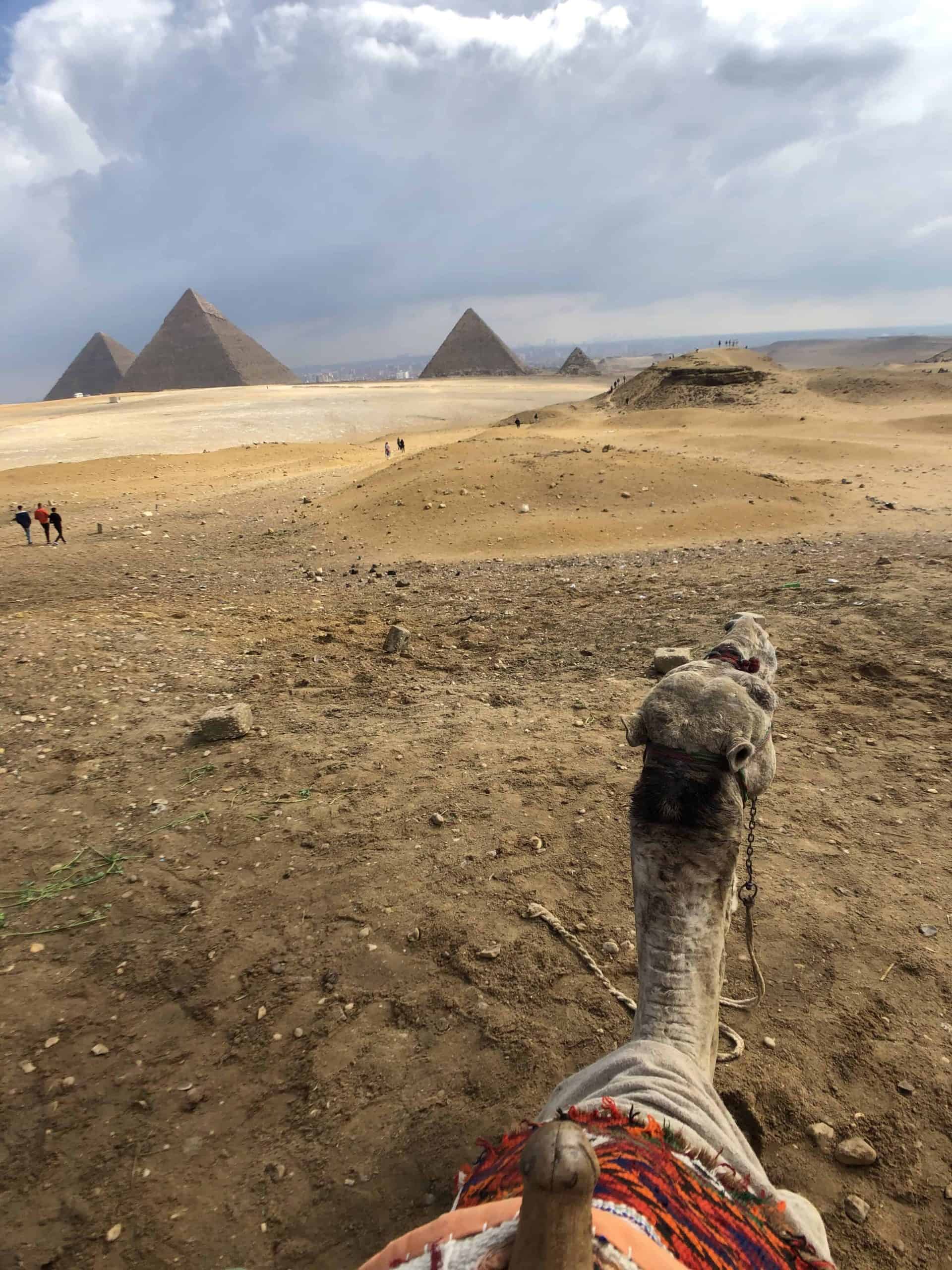
Just beyond the pyramids, near a row of waiting tour buses, we had the chance to ride camels with the great monuments looming in the distance. It was undeniably touristy, and yet incredibly fun — especially watching my friend teeter nervously on the lumbering creature. The handlers even helped us capture a few kitschy photos with the animals.

Next came the Great Sphinx. If I’m honest, it isn’t quite as imposing in person as media often makes it seem, but standing before such an ancient and mysterious figure is still unforgettable. Carved from a single block of limestone, with the body of a lion and the head of a pharaoh (most likely Khafre), the Sphinx has silently guarded the plateau for millennia. The platform was crowded, but by walking further around to the front, we found a quieter spot with the pyramids perfectly aligned in the background — a true “pinch me” photo moment.
Pro Tip: For the best photos, head to the panoramic viewpoint on the Giza plateau for wide pyramid shots, but don’t miss the spot just southeast of the Sphinx. From here, you can capture both the Sphinx and pyramids in perfect alignment. If you choose to ride a camel, confirm prices in advance — or better yet, arrange it through your guide to avoid haggling.
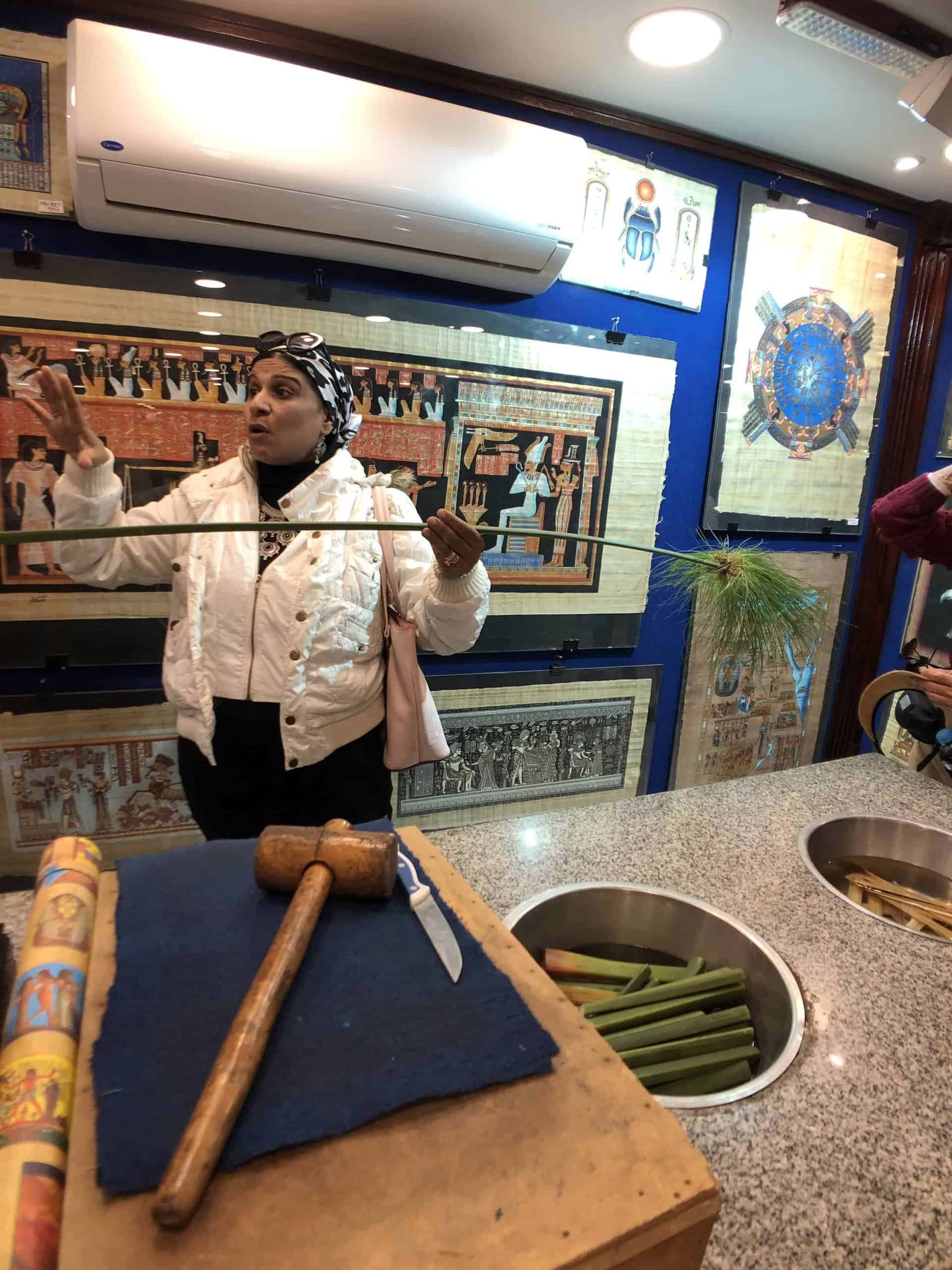
From there, our guide took us to a papyrus shop, where we watched artisans demonstrate the ancient process of turning reeds into the world’s first form of paper. Of course, we were also encouraged to browse their collection of papyrus art. I couldn’t resist commissioning a piece with my name written in hieroglyphics — because when in Egypt!


For lunch, we stopped at a traditional Egyptian restaurant where we learned how to bake Aish Baladi, a hearty local flatbread, before sitting down to a delicious family-style meal. We finished it off with an Egyptian beer called Stella (and no, not Artois).
Saqqara and Memphis
Re-energized, we continued to Saqqara, just outside Cairo, and home to the Step Pyramid of Djose, the earliest large-scale stone structure in history. Walking through the tombs here felt like entering an open-air museum. The highlight was stepping inside the Tomb of Kagemni, where we saw our very first real ancient hieroglyphics up close, still carved with remarkable clarity.


Our final stop of the day was Memphis, the first capital of ancient Egypt. Once the seat of pharaohs, its ruins today include statues and fragments that hint at its former grandeur. The standout is a colossal limestone statue of Ramses II, lying on its back in a dedicated pavilion. Even in repose, the details and sheer scale are striking.

Day 3: The Citadel of Saladin, The Egyptian Museum, and Khan El Khalili Market
Citadel of Saladin
Our day began with a visit to the Citadel of Saladin, one of Cairo’s most famous landmarks. Built in the 12th century as a fortress to protect the city, it later became the seat of Egypt’s rulers for centuries. Today, it’s most famous for the Mosque of Muhammad Ali, a gleaming alabaster structure that dominates Cairo’s skyline. But what makes the citadel even more fascinating is its multi-faith significance.
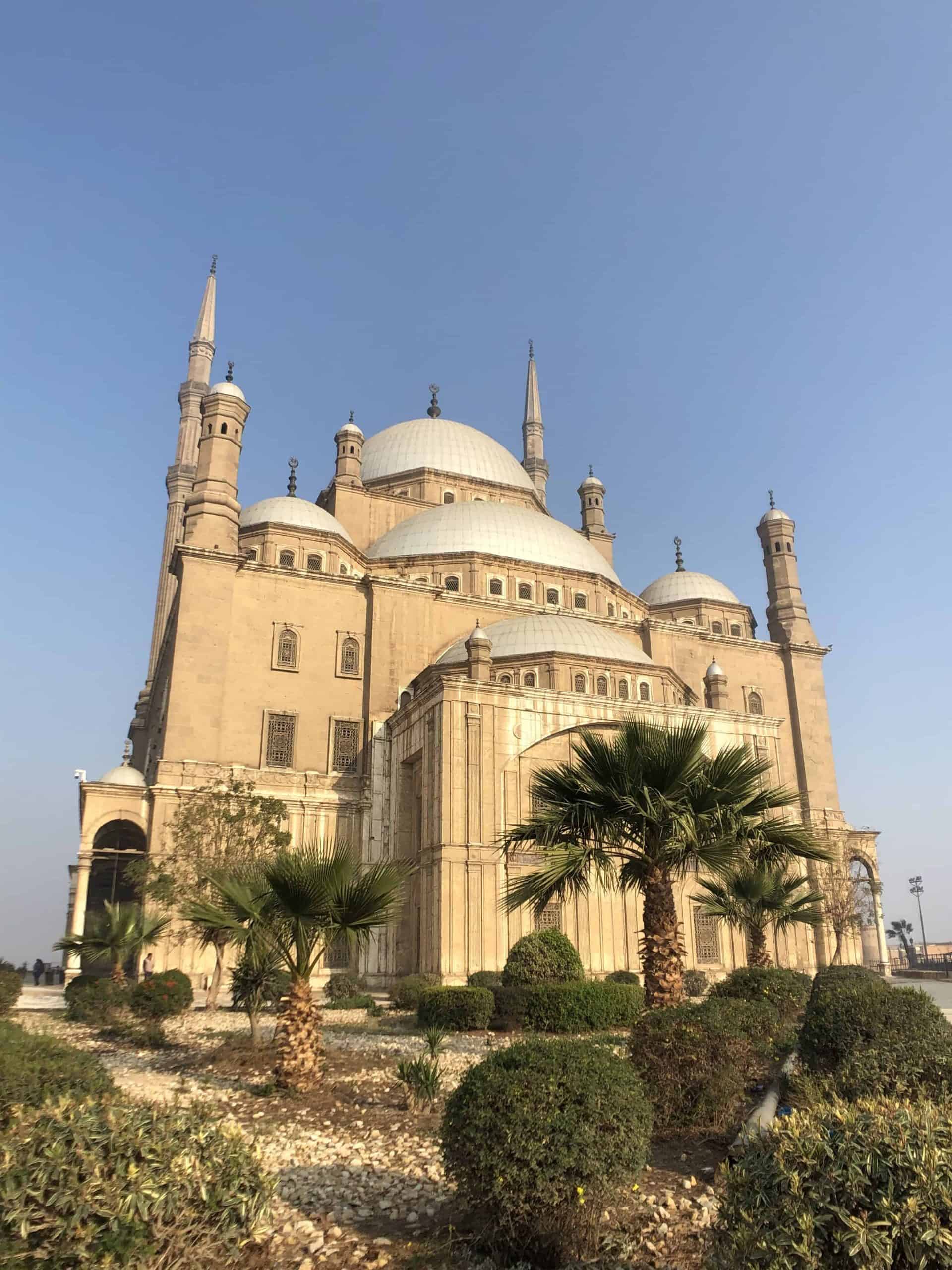

Over the centuries, this complex and the surrounding Old Cairo area have been used by Muslims, Christians, and Jews alike. Inside, you’ll find mosques, while just beyond the walls are important Coptic churches like the Church of St. George, and even the historic Ben Ezra Synagogue. Other important religious sites nearby included a church erected where Mary, Joseph and the baby Jesus were given asylum and a sealed well that they drank from. It’s a powerful reminder of Cairo’s layered history as a crossroads of cultures and faiths. Sahar was proud to mention the Egyptians fight for religious freedom only a few years prior to our trip.
ProTip: We visited first thing in the morning which was nice as the crowds were light. For the best shot of the Muhammad Ali Mosque, take photos from the terrace overlooking Cairo.
Khan El Khalili Bazaar

For lunch and a little down time, we visited the colorful chaos of Khan El Khalili Bazaar, where the narrow alleys are filled with spices, lanterns, and the aroma of fresh mint tea. It’s touristy, yes, but also a lively and authentic part of Cairo’s culture. Bargaining here isn’t just allowed, it’s expected, and often done with good humor.
My travel companion and I made sure to relax in one of the Ahwas for some tea and relaxation since we were still recovering and exhausted by our late flight and busy days. Directly after we visited an oil shop where we were able to test and purchase decorative bottles of deliriously scented oils like Frankincense and Myrrh or Lotus Flower.
Pro Tip: Bring cash in small bills, and if something catches your eye, don’t hesitate—you may not find it again in the maze-like alleys!
The Egyptian Museum
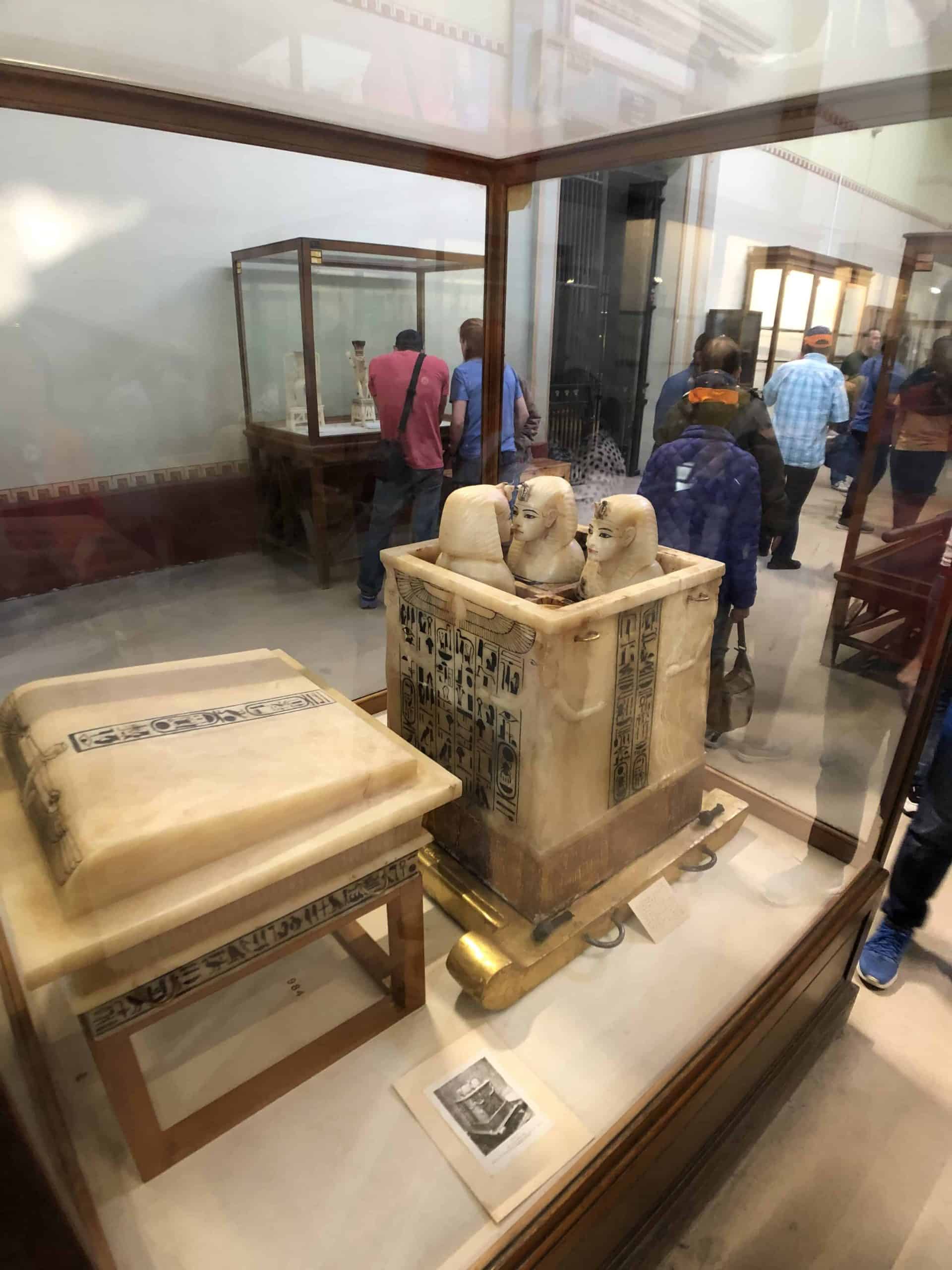
The second half of the day was spent exploring the Egyptian Museum, still housed in its original 1902 building in Tahrir Square at the time of our trip. A little bit of a bummer, but also kind of fascinating to witness, much of the collection was actually being packed up for its move to the new Grand Egyptian Museum (now open). It made for a slightly chaotic visit, but we still got to see plenty of its artifacts, including the mummy room and a collection of King Tutankhamun’s treasures.



For dinner we were taken to the Scarabee river barge restaurant for a dinner show of traditional dancing and entertainment. It was a nice way to end the evening and to round out our 3-day tour of Cairo.
Pro Tip: I highly recommend using a guide for context — the collection is overwhelming — but also allow yourself several hours to explore independently at your own pace because sometimes the tours can seem rushed. If you’re planning your trip now, the Grand Egyptian Museum near Giza is open, offering a far more spacious and modern display.
Day 4: Luxor and Karnak and Cruising The Nile
An early morning flight took us to Luxor, where we met our new Egyptologist, Kareem, who would serve as our guide for the remainder of our trip. Kareem was extremely knowledgeable and personable, so much so that we kept in touch with him through Facebook long after the trip.


It had been a bucket list dream of mine to sail the Nile for as long as I could remember. As we boarded our River Cruise ship, it felt surreal to finally be living out my dream. The M/S Semiramis would be our home for the next several nights as we sailed down the Nile, exploring the heart of ancient Egypt from the comfort of the water.
On our first day we stopped at two of the most famous sites in the region: Karnak and Luxor Temples.
Temple of Karnak


Karnak is, without doubt, one of the most spectacular temples we visited in all of Egypt. The approach alone is breathtaking, with a daunting row of ram-headed sphinxes leading to the front gate. Inside, the vast complex of pylons, chapels, and obelisks stretches out like a city of stone. It’s hard to wrap your head around the scale of it all, and harder still to imagine how well it has remained preserved over millennia.
The Hypostyle Hall, with its 134 massive sandstone columns, is absolutely jaw-dropping. Walking through the hall feels like entering a forest of stone trees; the sheer height of the pillars makes you crane your neck skyward, imagining the painted stars that once decorated the now deteriorated ceiling. The scale alone is overwhelming, but it’s the artistry, the hieroglyphics and carved figures etched into every surface, that really brings it to life. With the bland stone facades, it is hard to imagine that each pillar was once painted brightly.
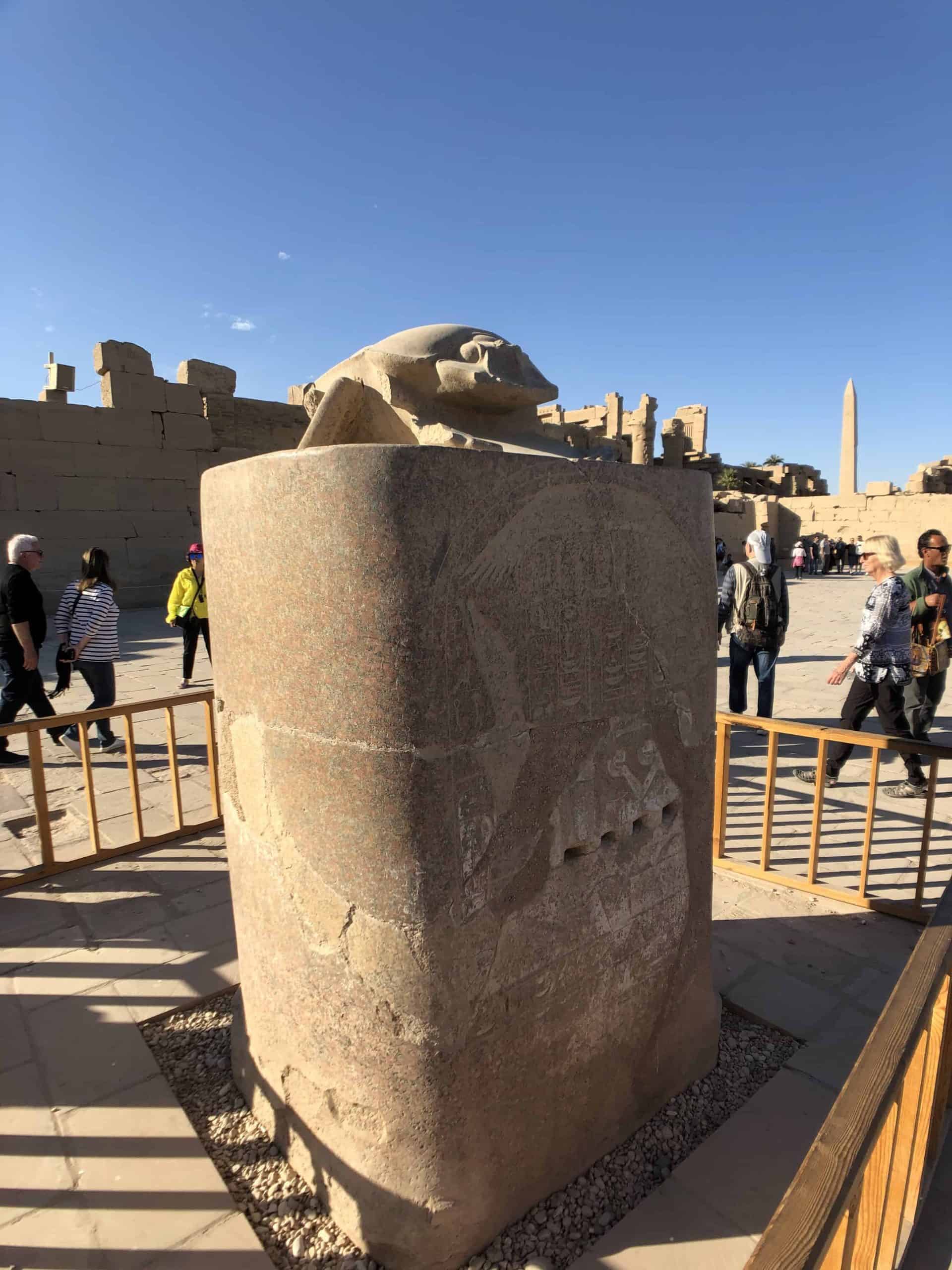
Pro Tip: At Karnak Temple, don’t miss the granite scarab statue near the Sacred Lake — a powerful symbol of rebirth and good fortune linked to the god Khepri. It’s a small gesture, fun and meaningful in its own way, and makes for a memorable moment in the temple complex. Local tradition suggests walking in a counterclockwise direction:
- 3 circles for general good luck
- 7 circles to attract love or marriage
- 9 circles to bless childless couples with the joy of pregnancy
Temple of Luxor
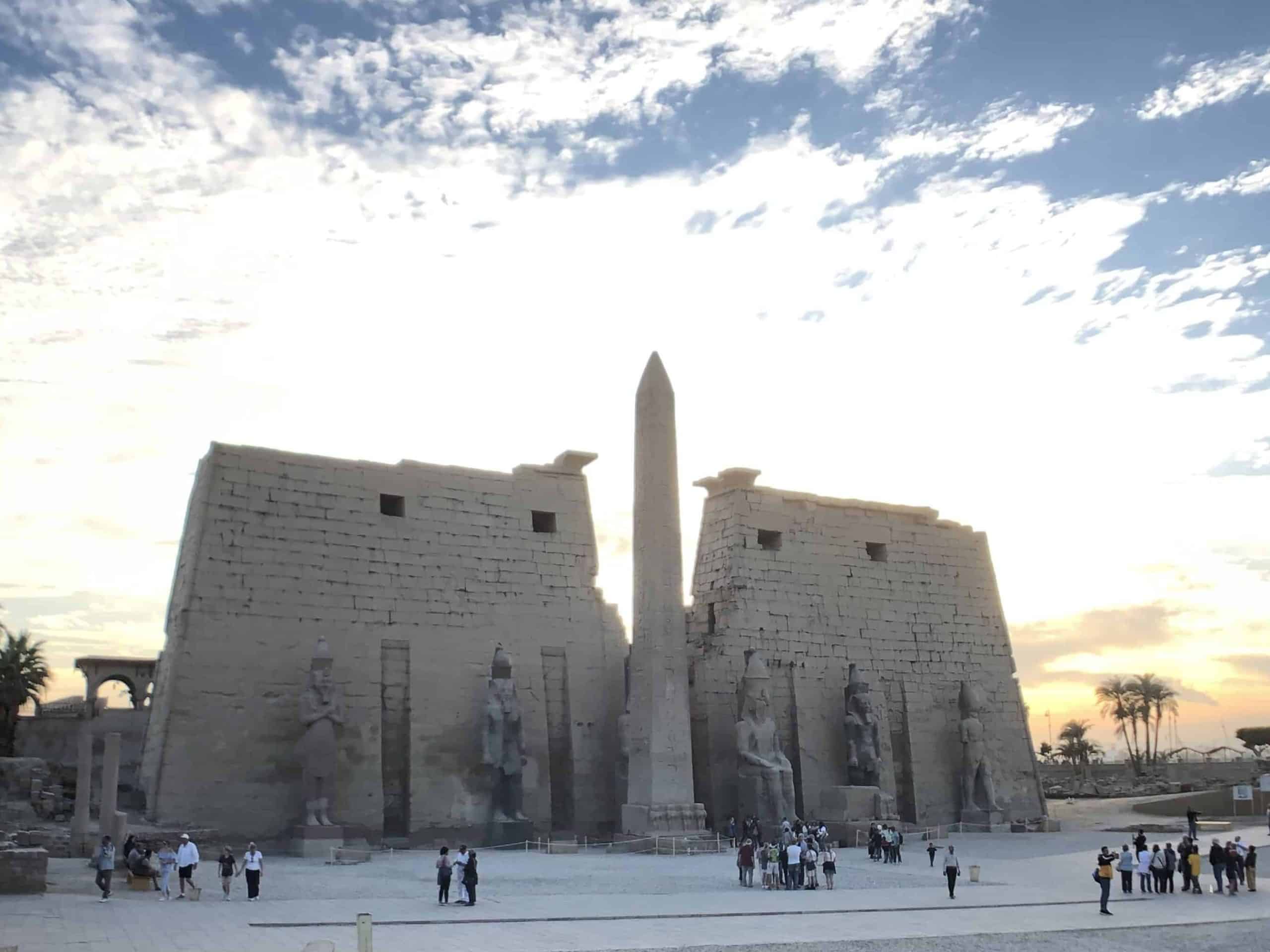
Our second stop was the Temple of Luxor, with its towering gates and lone obelisk at the entrance (its twin stands today in Paris, France at the Place de la Concorde). Luxor Temple feels more intimate than Karnak, yet no less powerful. Colossal statues of Ramses II line the entryway, some of them depicting him seated beside his queen — a rare and symbolic gesture that shows her equal standing in their reign, something I’ll describe further in my Abu Simbel section below.

Once connected to Karnak by the Avenue of Sphinxes, Luxor Temple was a place of ceremony and procession, especially during the annual Opet Festival. Today, its grandeur remains palpable, especially at dusk when the sandstone glows in the fading sunlight. We stayed well beyond sunset to watch the moon, and stars rise over the ruins of the magnanimous temple, an incredible sight to behold.
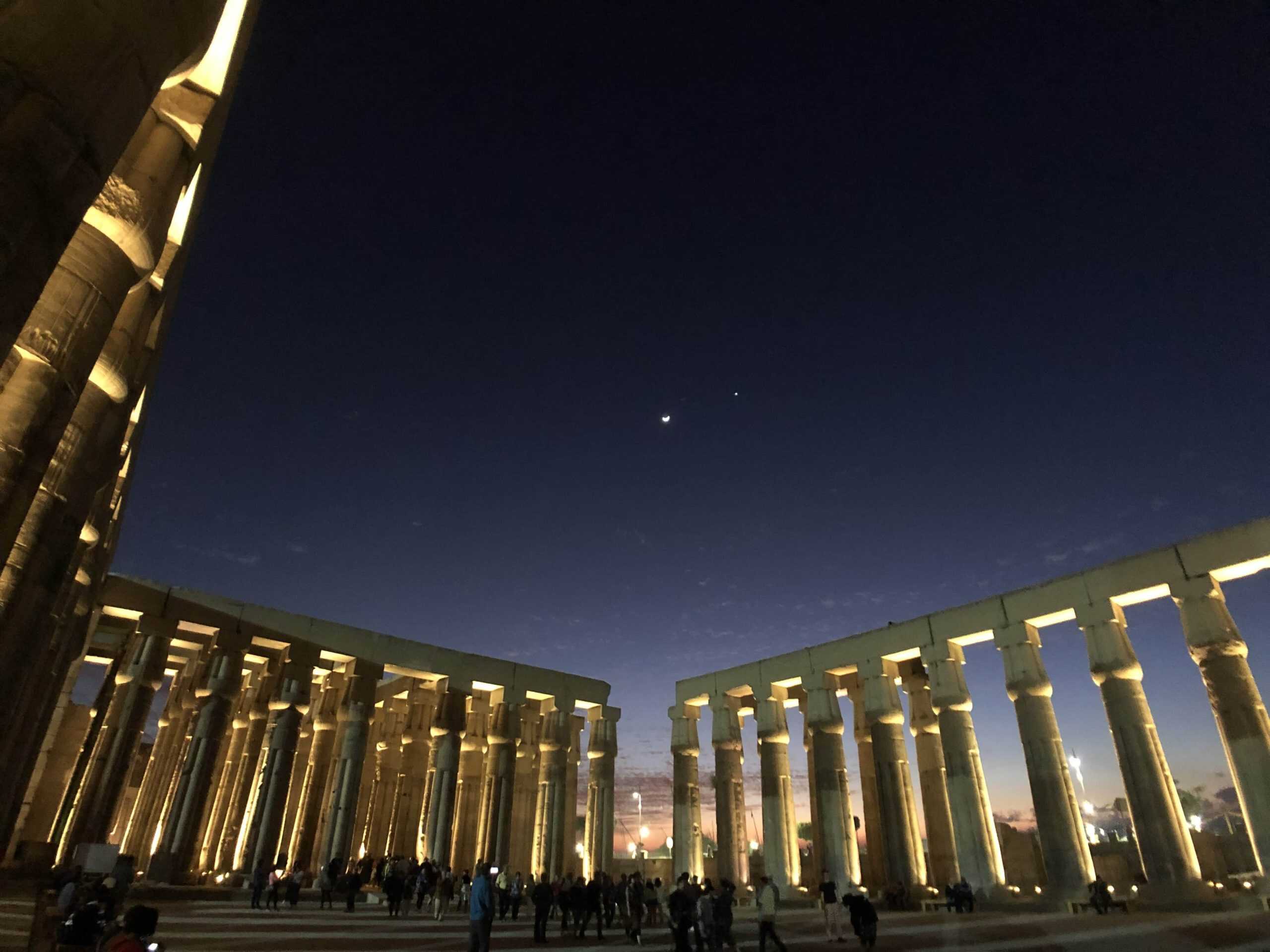
Pro Tip: If you can, visit Luxor Temple at sunset — it truly is magical. The glow of the stone against the fading light makes it incredibly atmospheric.
Day 5: Valley of the Kings, Hatshepsut’s Temple & the Colossi of Memnon
Our next morning began with a hearty breakfast on the ship before setting out for one of the most anticipated days of the entire trip: exploring the West Bank of Luxor. This area is a treasure trove of pharaonic history, home to elaborate tombs, grand temples, and colossal statues that once guarded a magnificent necropolis.
The Valley of the Kings

Walking into the Valley of the Kings feels like stepping straight into the pages of an ancient storybook. Nestled in the barren cliffs, this desert valley hides more than 60 tombs belonging to pharaohs and nobles of the New Kingdom, including the world-famous tomb of Tutankhamun. While many tombs have long since been looted, the artistry that remains is astonishing — hieroglyphs painted in vivid colors, ceilings decorated with constellations, and corridors lined with carvings that detail a pharaoh’s journey to the afterlife.
We were able to explore a handful of tombs (your ticket grants access to three, with others available for an additional fee). We resisted the urge to visit King Tut’s tomb, which is a popular choice for obvious reasons, but we had heard from our guide that it was not the most impressive and that much had been removed and placed in the museum collection. Instead, we visited the tombs of Ramses IV, Ramses IX, and Merenptah. Each one felt distinct in design and atmosphere, and it’s mind-boggling to imagine the manpower and skill it took to carve these subterranean chambers thousands of years ago.

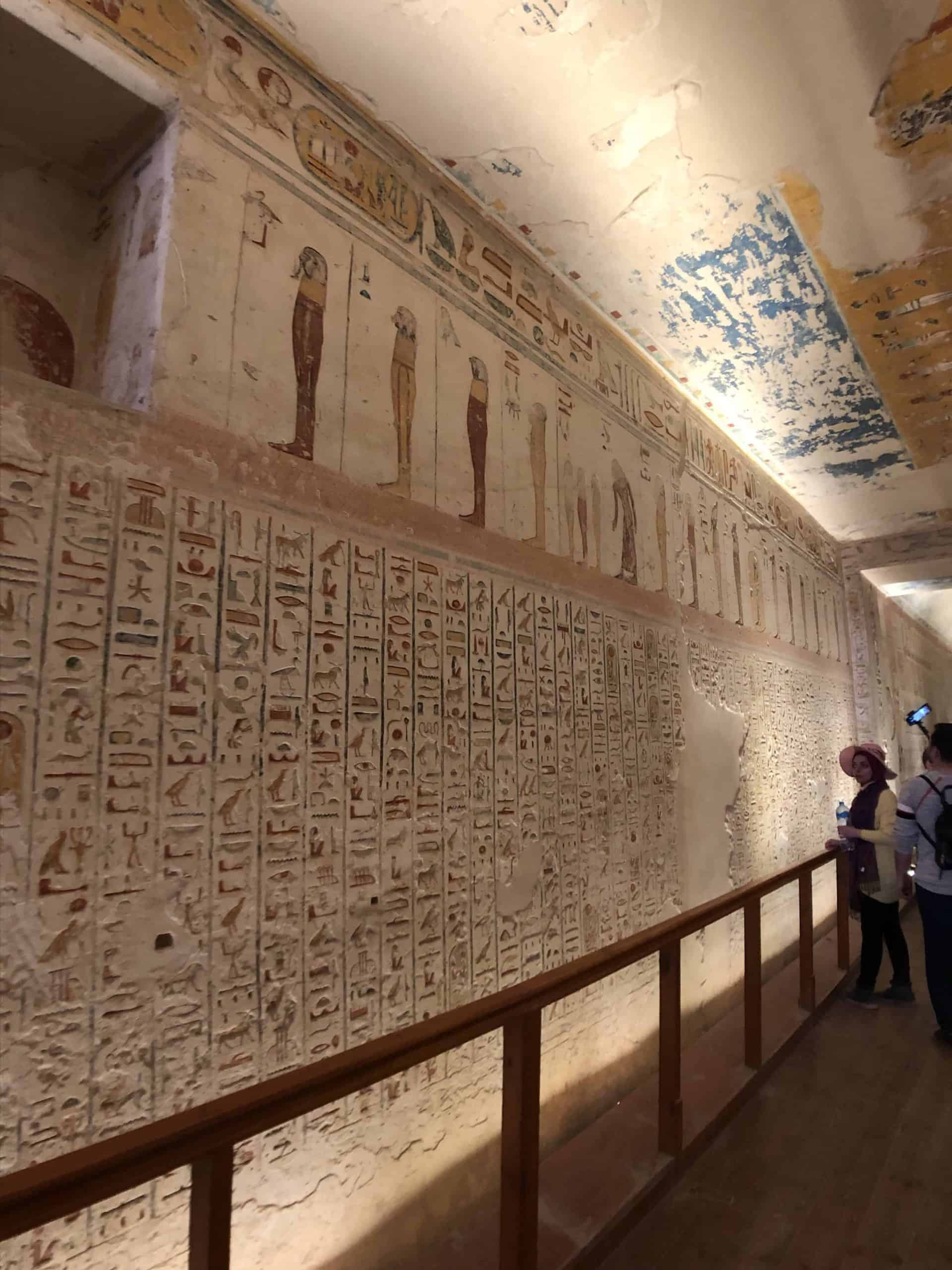

Stepping into an ancient tomb is unlike any other experience in Egypt. You feel both like an honored guest and an intruder, coming face-to-face with your own fragile humanity and the endurance of human legacy. The air grows cooler and heavier as you descend the narrow passage, and the sound of the outside world fades away. The torchlight that once guided priests through these same corridors thousands of years ago is now replaced by dim electric lights that reveal walls still alive with color — vivid reds, blues, and golds that defy time. The hieroglyphs and painted scenes tell stories of gods, kings, and the promise of eternity. I found it humbling, and even a little eerie, to stand in a space designed to protect a pharaoh’s soul forever.
Pro Tip: Do your best to remain quiet and respectful when visiting the tombs in the Valley of the Kings. The description above is honestly how I felt walking the dim corridors, but sometimes the peace was broken by the disrespectful banter of tourists.
Bonus Tip: While the Valley of the Kings is a must, consider adding a visit to the nearby Valley of the Queens if time allows. Though less famous, some of the tombs here are even better preserved, with brighter colors and equally impressive artistry. The tomb of Queen Nefertari, in particular, is one of the most stunning in all of Egypt.
Temple of Hatshepsut
From there, we drove to the striking Mortuary Temple of Hatshepsut, nestled dramatically beneath towering limestone cliffs at Deir el-Bahari. This temple is unlike any other in Egypt, with its tiered terraces and long colonnades giving it an architectural elegance that feels almost modern.

Hatshepsut (pronounced: hatchet-soup), for me, was one of Egypt’s most fascinating figures. One of the few women to rule as pharaoh in her own right for over 20 years, she solidified her claim by having herself depicted with the traditional symbols of kingship, wearing a false beard and male regalia. She even crowned her own daughter as queen, letting her rule beside her.
The temple not only commemorates her reign, which was one of peace, prosperity and innovation, but also demonstrates her ambition to legitimize her rule alongside the great kings of the past. Walking up the sweeping ramps, you can still see remnants of painted reliefs depicting trade expeditions to the Land of Punt and other highlights of her reign.
Pro Tip: Visit early in the morning if you can; the temple gets hot quickly as the sun rises against the cliffs, and the crowds build fast. This is also a great place for wide-angle photos, as the symmetry of the terraces framed by the cliffs makes for stunning shots.
The Colossi of Memnon
Our final stop of the day was the Colossi of Memnon, two massive statues of Pharaoh Amenhotep III, one of Egypt’s most influential pharaohs, who ruled during a golden age of peace and prosperity. Even in their weathered state and with no temple left to guard, the statues are impressive, each towering over 60 feet high and carved from single blocks of quartzite.

Once standing guard at the entrance to his grand mortuary temple (long since destroyed), these giants have been fascinating visitors since antiquity. In fact, during the Greco-Roman period, one of the statues emitted a “singing” sound at dawn (likely due to cracks heating up in the sun), which made it famous as an oracle.
Pro Tip: This stop is quick, but don’t miss the chance to stand at the base of the statues for perspective — their scale against the empty plain is humbling. Many tours only pause here briefly, but a few extra minutes to soak in the atmosphere makes it memorable.
Day 6: Edfu and Kom Ombo
Edfu
We reached the coast of Edfu early, where horse-drawn carriages line up to take tourists to the Temple of Horus. While the temple itself is beautiful, one of the best-preserved in Egypt, the ride there was difficult for me. The horses appeared underfed and overworked, and I felt rushed and pressured to go along with it to stay with the group. I do not typically get emotional about these things, I grew up on a farm and am familiar with working animals, but I couldn’t help but be visually upset, even furious over the condition of these poor creatures. I regret to this day not refusing to participate in the ride, and was sure to make my voice heard on the issue later with the tour company.

The Temple of Edfu, dedicated to the falcon-headed god Horus, greeted us with towering walls and etched figures that were every bit of 20 feet high themselves. It was an incredible sight. It is one of the best-preserved temples in all of Egypt, built during the Ptolemaic period (around 237–57 BCE). Inside, the walls are lined with hieroglyphs that tell mythological tales, including the great battle between Horus and Seth, the god of chaos.


The inner sanctuary, still containing the granite shrine that once held Horus’s sacred statue, feels almost otherworldly in its dim, incense-scented quiet. Unlike some of the more ruinous sites, here you can walk the winding halls and staircases and really imagine what temple life must have been like thousands of years ago.
Pro Tip: If possible, find an alternative way to reach the temple, such as a tuk-tuk or walking if time allows. The temple is worth seeing, but the carriage ride is not an experience I’d recommend.
Kom Ombo Temple

Later that day, we sailed to Kom Ombo, a unique riverside temple dramatically set on a bend of the Nile. What makes Kom Ombo so special is that it is a double temple, with one side dedicated to Horus the Elder (the falcon god), and the other to Sobek (the crocodile god). This dual dedication is reflected in its perfectly symmetrical design: twin entrances, twin halls, twin sanctuaries. It feels as though two temples were stitched together into one.
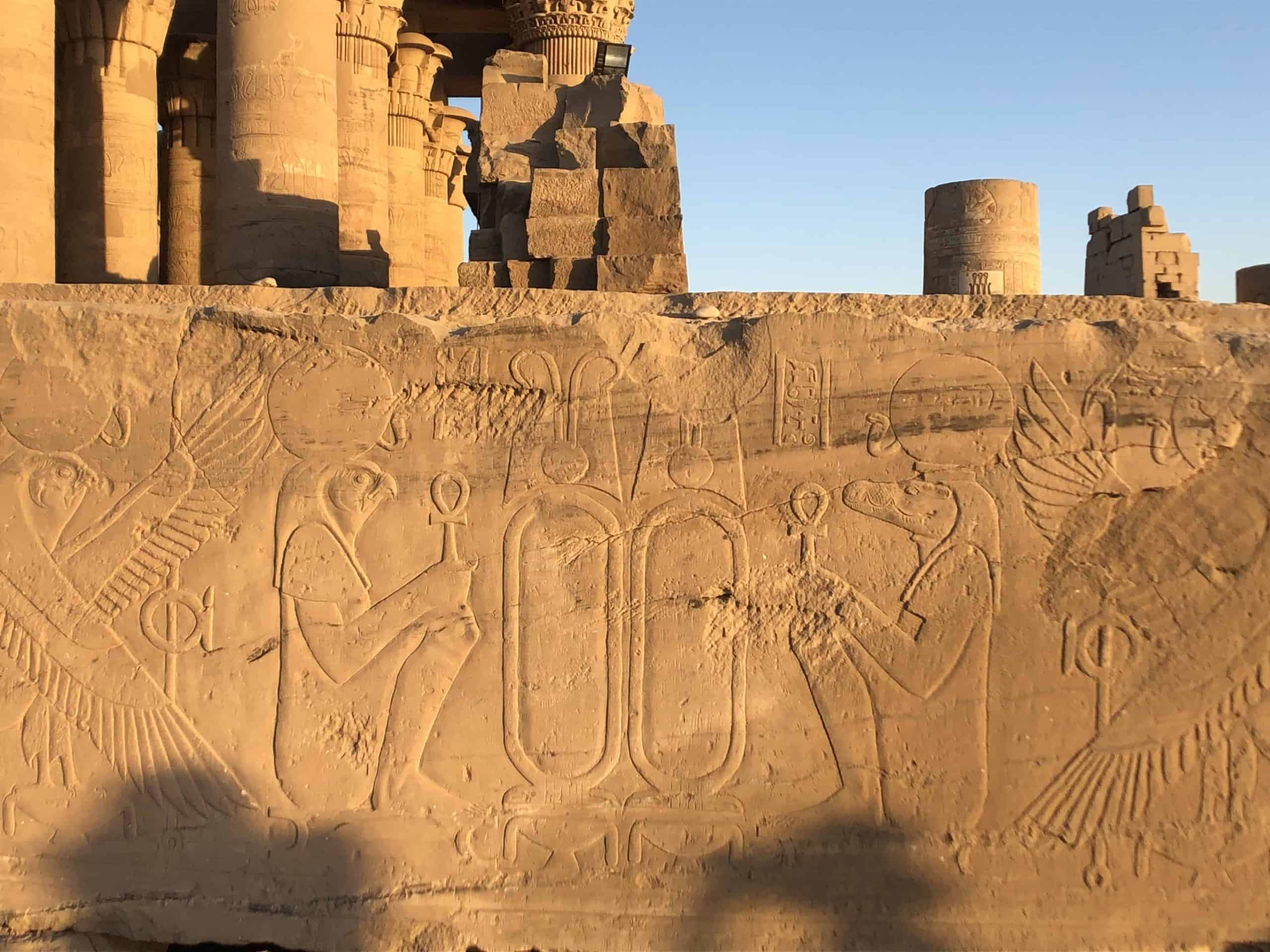
Standing at Kom Ombo as the Nile flowed past, you really feel how deeply the river shaped Egyptian civilization — feeding its fields, inspiring its gods, and dictating the rhythms of life. The setting sun cast a golden glow over the temple as we explored its carvings, which included one of the earliest depictions of medical instruments — scalpels, forceps, and other tools that hint at the advanced knowledge of the time.
Our ticket to the temple also included entrance into the small but fascinating Crocodile Museum nearby, which houses dozens of mummified crocodiles once worshipped as living incarnations of Sobek. Seeing them perfectly preserved was both eerie and kind of cool.

Pro Tip: Kom Ombo is particularly atmospheric at sunset. Time your visit for the evening if you can, when the fading light and cooler air bring a sense of mystery to the temple. Don’t miss the Crocodile Museum, it’s small but fascinating, and is included in your ticket.
Day 7: Abu Simbel
One of the absolute highlights of the trip for me personally was the journey to Abu Simbel, built by Ramses II. I had done a bit of reading on Ramses II, one of Egypt’s most powerful and long-reigning pharaohs (66 years), and his beloved wife Nefertari — a queen with mysterious origins whose influence, intelligence, and adoration can be seen throughout Ramses’ reign. She was honored with titles like “She for whom the sun shines” and “Mistress of Upper and Lower Egypt” inscribed on walls across the land. I was particularly excited to come face-to-face with their matching mortuary temples, and let me tell you, the experience was well worth the four-hour drive through the desert.

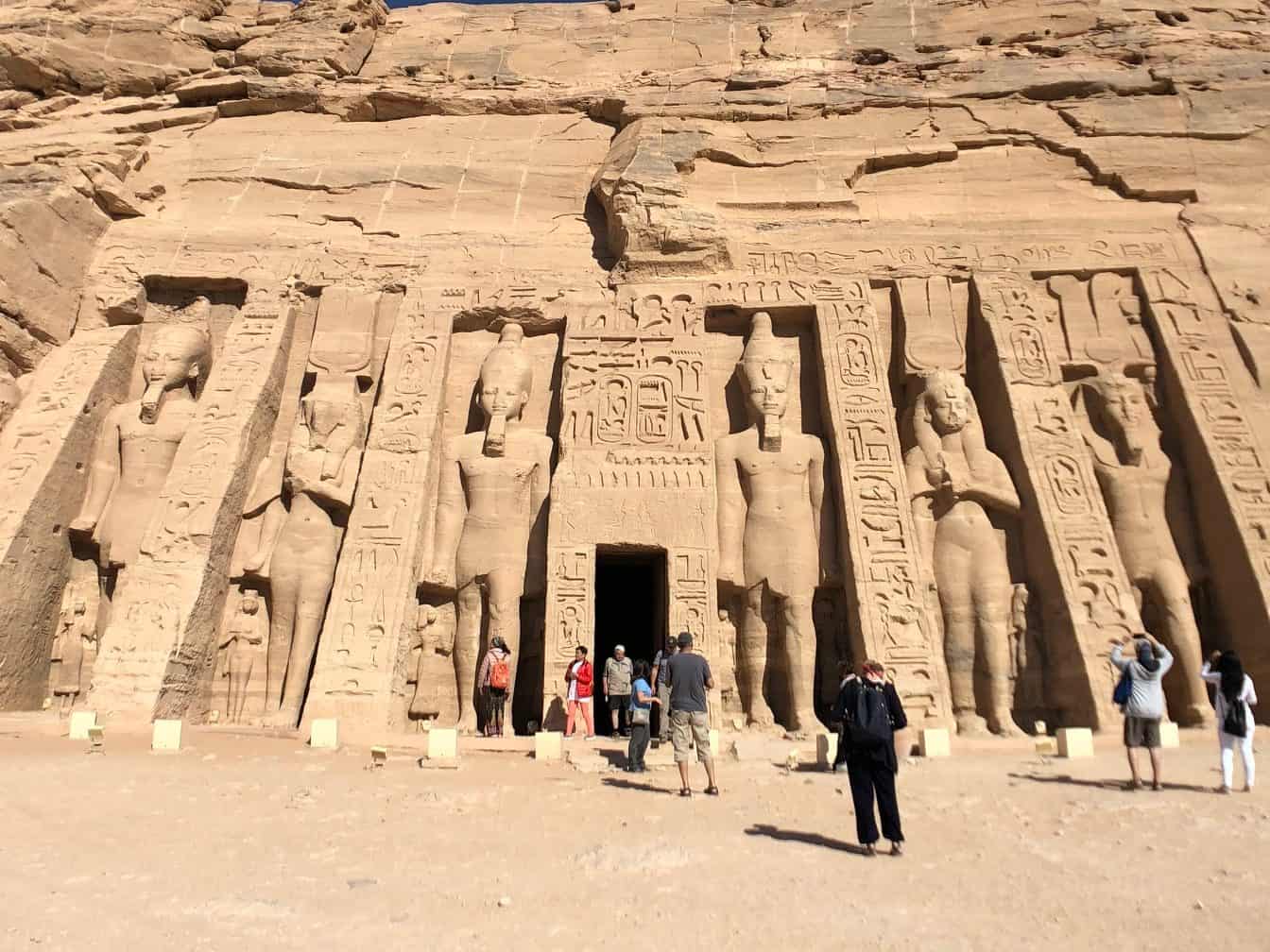
The main temple, built for Ramses II himself, is aligned so that on just two days of the year, the rising sun illuminates three of the four seated gods inside — leaving Ptah, the god of the underworld, in eternal darkness. It’s a feat of engineering and cosmic alignment that still amazes archaeologists today.
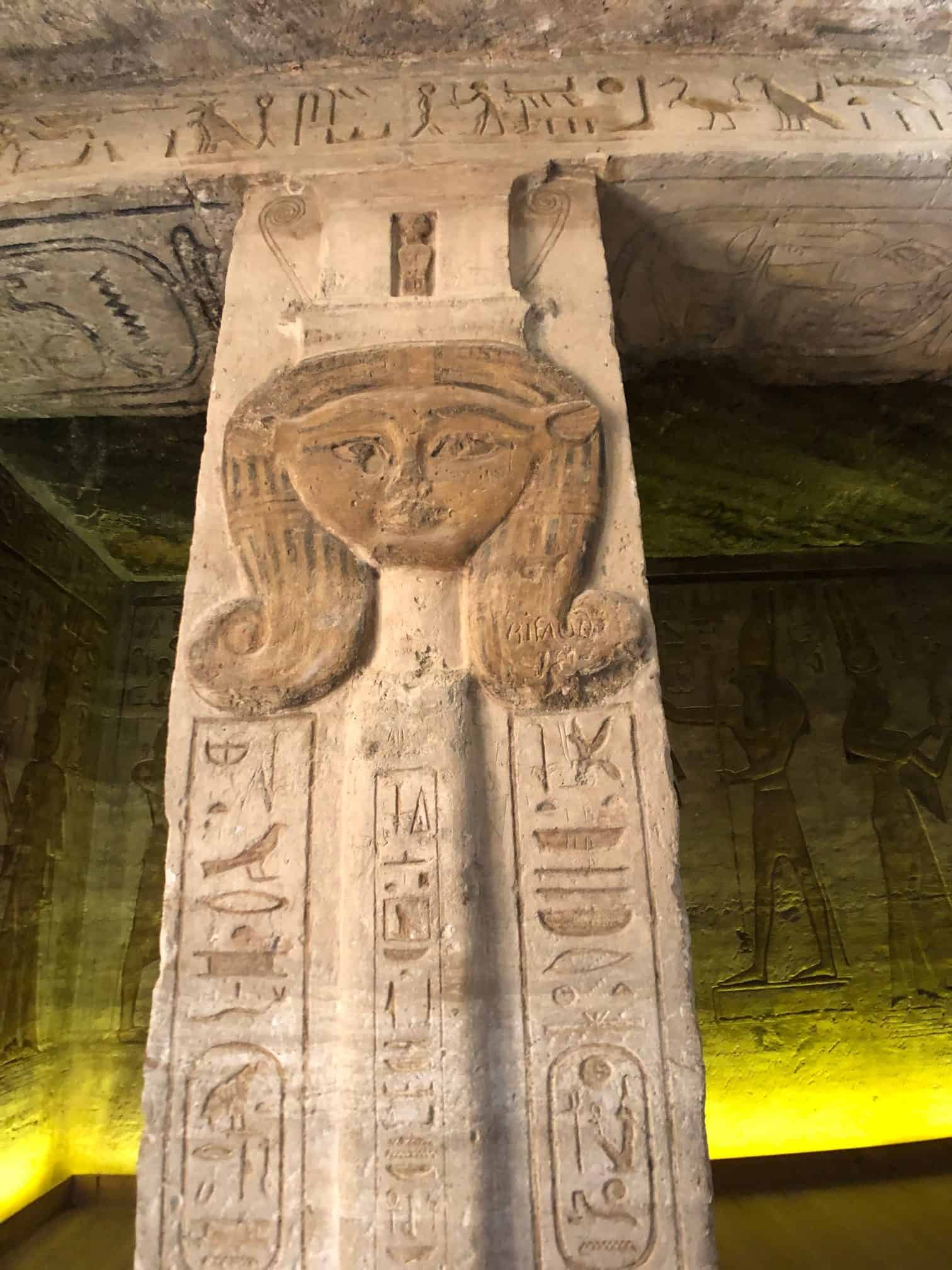
Next to Ramses’ temple is the Temple of Nefertari, dedicated to his queen and the goddess Hathor. Ramses II honored Nefertari in an extraordinary way at Abu Simbel. In a radical departure from tradition, this was the first time in Egyptian history that a pharaoh depicted his queen at the same scale as himself — a striking symbol of her importance. Typically, queens were shown as much smaller, secondary figures, but here Nefertari quite literally stands shoulder to shoulder with her king.
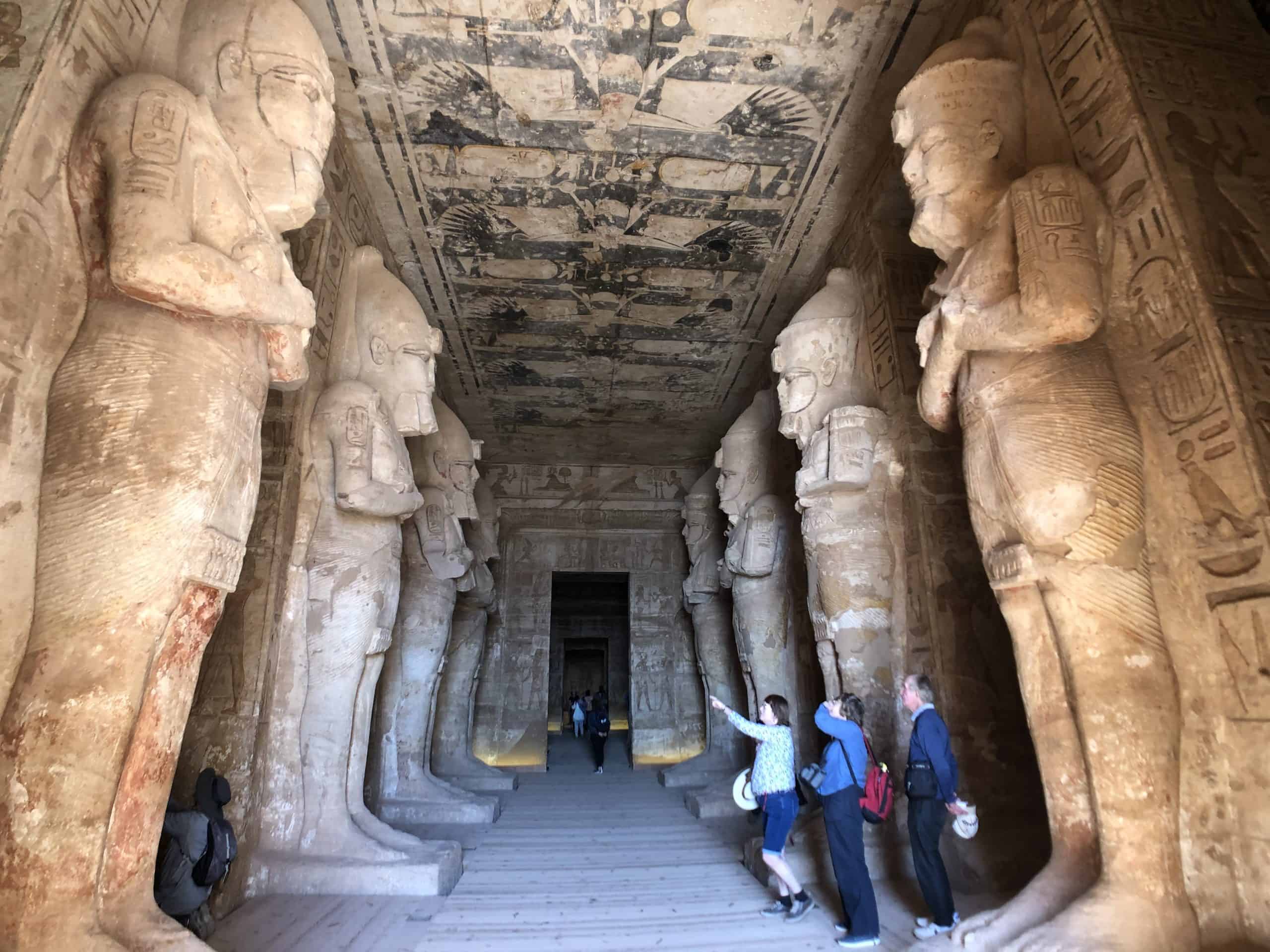



Another extraordinary fact is that the temples you see today are not in their original location. In the 1960s, when the Aswan High Dam was built and Lake Nasser threatened to submerge the site, a massive international effort led by UNESCO undertook the relocation of the temples. Over a period of four years, the entire complex was cut into enormous blocks, weighing up to 30 tons each, and carefully reassembled on higher ground (I know highway projects here in Florida that took longer than that). It remains one of the greatest feats of archaeological preservation in modern history, and you can watch a documentary and follow the timelines of events at the site.
Pro Tip: Visiting Abu Simbel requires some planning. The overland route from Aswan is a four-hour drive each way through the desert, so expect a very long day if you go by bus or car. A more convenient option is to take a short domestic flight from Aswan or Cairo, which dramatically cuts travel time. If you can time your visit for February 22 or October 22, you’ll witness the incredible solar phenomenon when the morning sun perfectly illuminates the temple’s inner sanctuary — a once-in-a-lifetime experience.
Bonus Tip: For a slower, more immersive experience, you can also sail across Lake Nasser on a multi-day cruise, which stops at lesser-known temples along the way before culminating at Abu Simbel — it’s a spectacular way to approach the monument by water.
Day 8: Aswan – The High Dam, Unfinished Obelisk, and Philae
It was time to say goodbye to our Nile cruise, and while we hated to depart our floating home, we had a full day of activities ahead before we transferred to the airport for our short flight back to Cairo.
Philae Temple


The highlight of the morning was undoubtedly Philae Temple, dedicated to the goddess Isis. Like Abu Simbel, Philae was saved from submersion during the construction of the High Dam. The temple complex was painstakingly relocated to Agilkia Island, stone by stone, to preserve its beauty. Approaching the temple by water felt magical — a grand colonnade rising from the river, surrounded by lush greenery and calm waters. The temple itself is breathtaking, with beautifully preserved reliefs that depict Isis, Horus, and Osiris. The sanctuary of Isis was considered one of the holiest places in ancient Egypt, and it’s not hard to see why.
Unfinished Obelisk
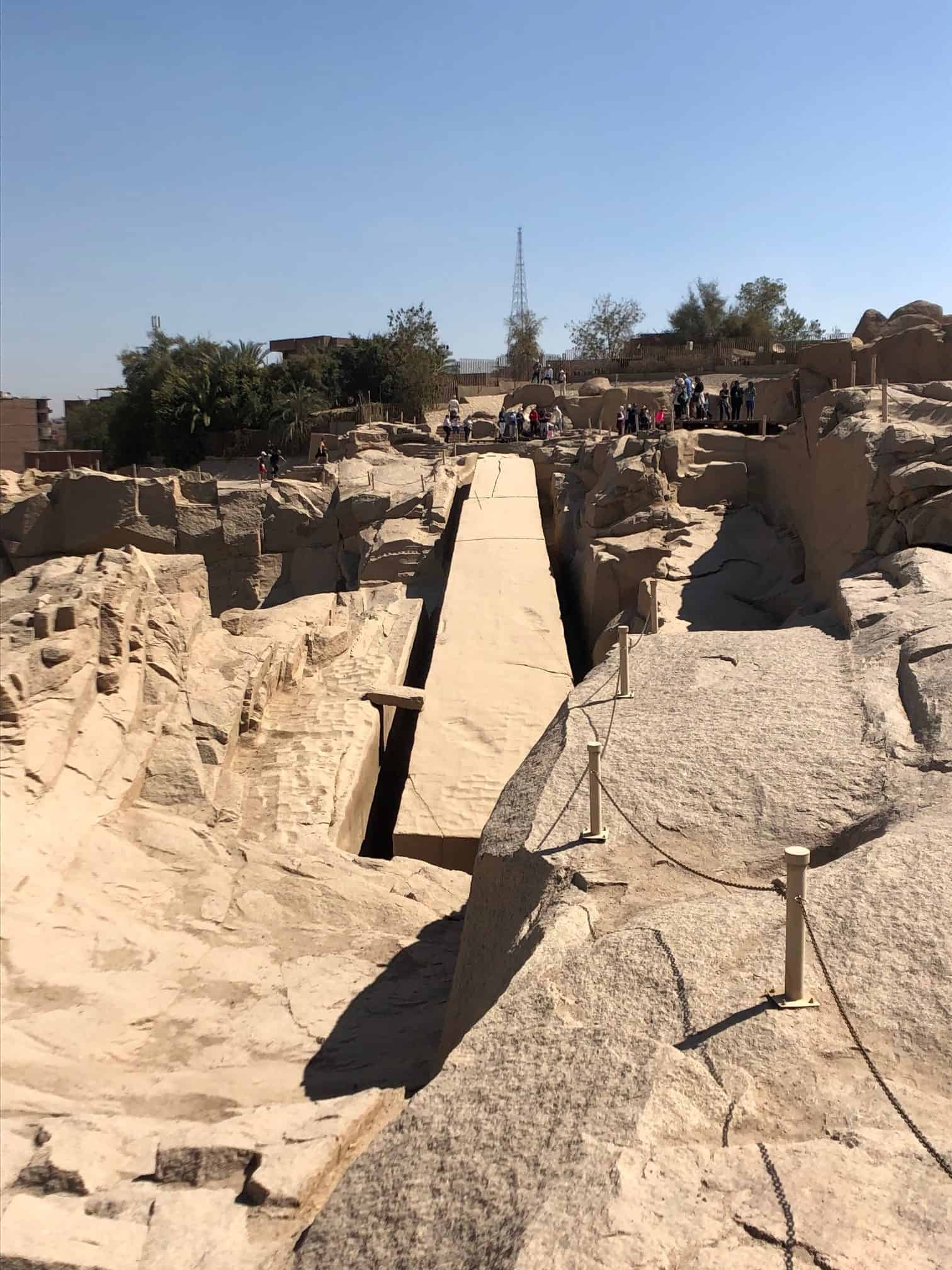
Next, we visited the Unfinished Obelisk, still lying in the same granite quarry where ancient artisans began carving it. If it had been completed, it would have been the largest obelisk ever erected, but a crack in the stone forced them to abandon it. Walking around the site, you can actually see the marks left by the workers’ tools thousands of years ago — a rare, raw glimpse into how these colossal monuments were shaped.
Felucca Ride
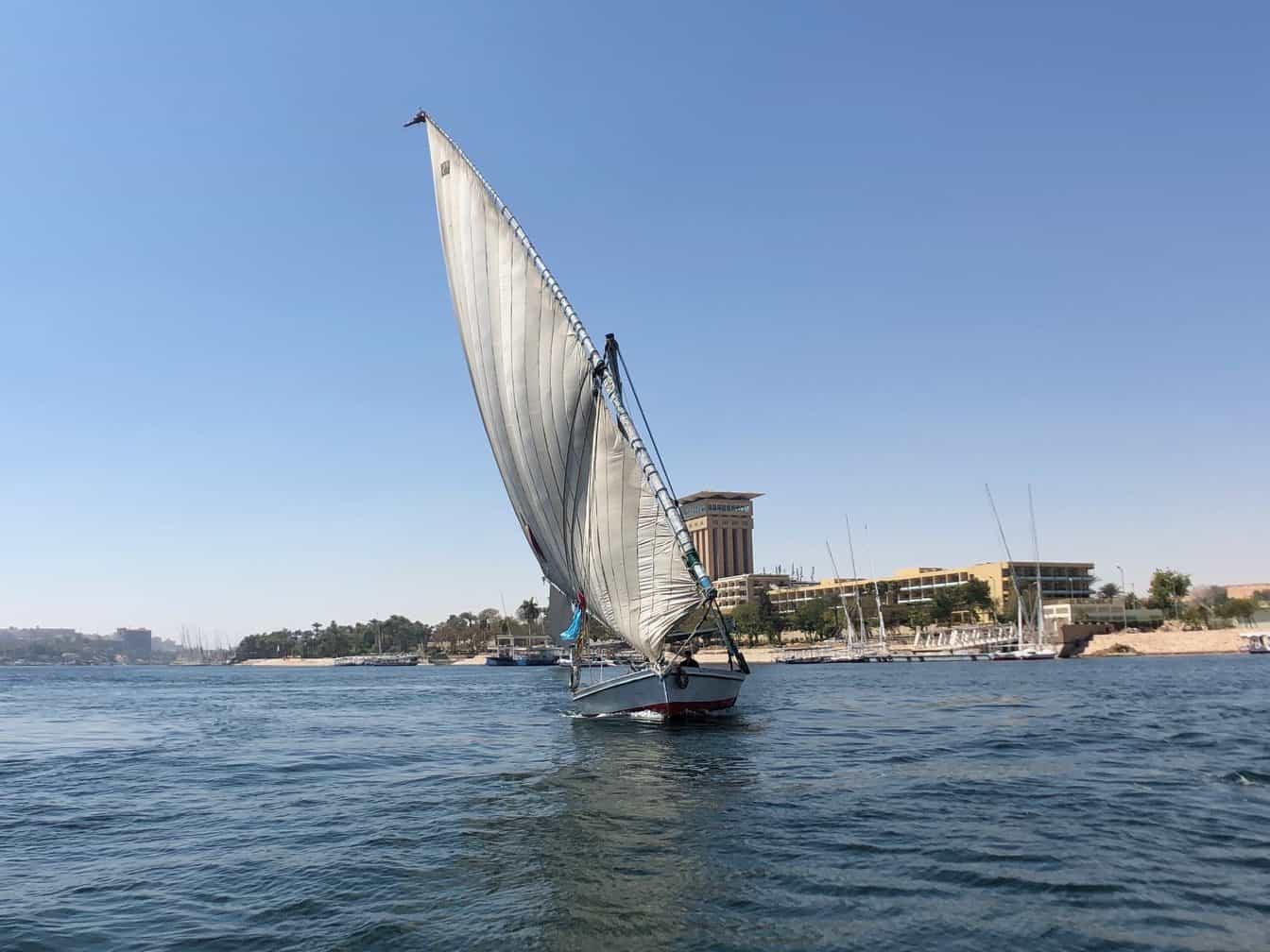
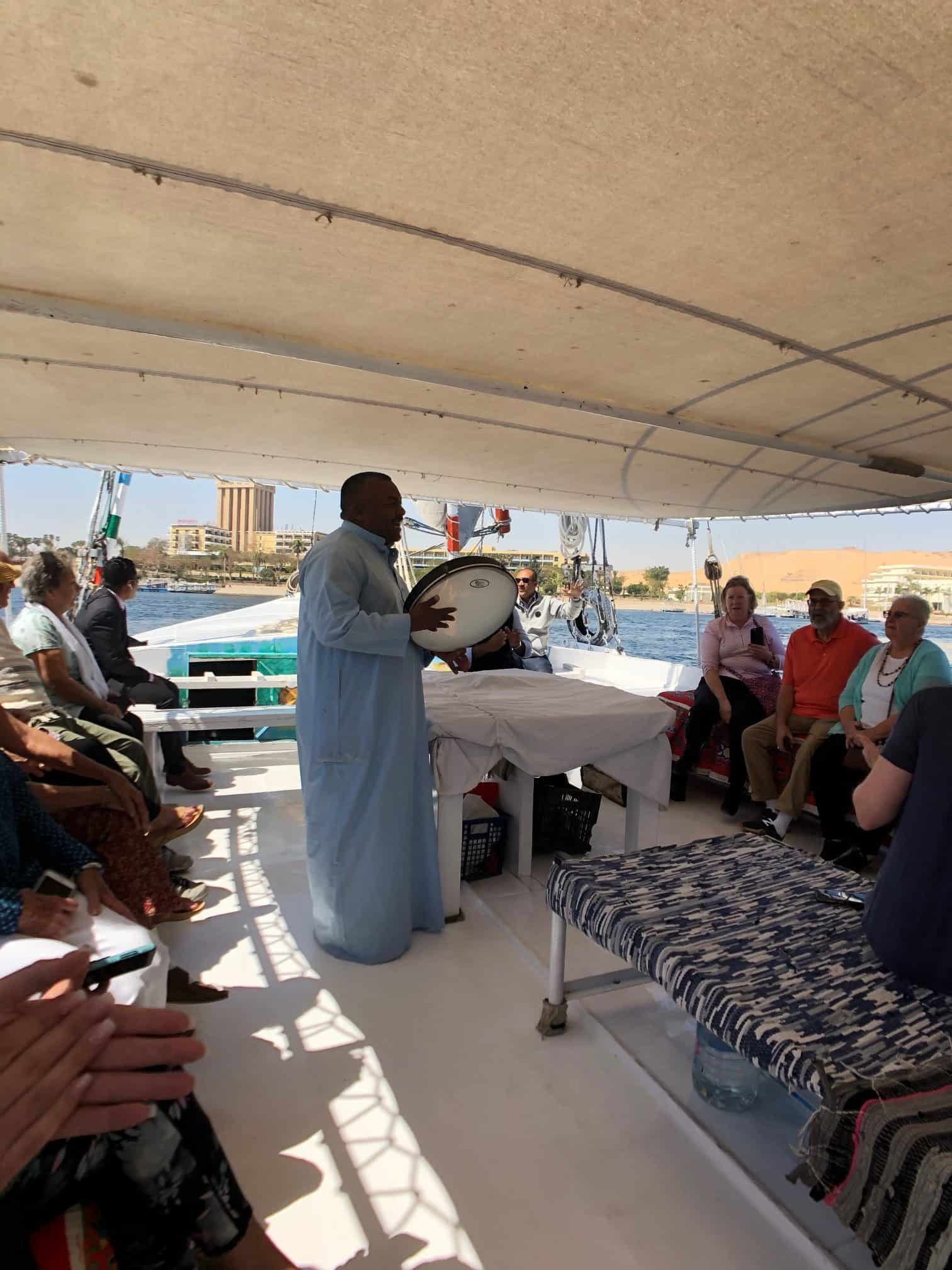

To round out an absolutely perfect Egyptian adventure in Aswan, we enjoyed a lovely afternoon aboard a traditional felucca sailboat, its white canvas sails catching the breeze as we glided across the Nile. Onboard, local musicians played lively Nubian songs while we were treated to light snacks and tea. The combination of the music, the gentle rocking of the boat, and the sight of the glowing dessert hills in the background made it one of the most atmospheric moments of the trip.
Pro Tip: When visiting Philae, try to go early in the morning or just before closing for fewer crowds — the tranquility makes it easier to appreciate the temple’s sacred feel. Also be aware, there are lots of stray cats looking for affection and a snack on the island.
Day 9: Farewell
An early morning departure brought our journey to a close. As I boarded my flight, I couldn’t help but reflect on the sheer scope of what we had seen in just over a week. Egypt is overwhelming, magical, and utterly unforgettable. But our journey wasn’t quite over yet. My friend and I had tacked a 2-day tour of Jordan and Petra onto our Egyptian adventure, and that was our next destination. Stay tuned for my next blog about Jordan.
Planning Your Own Egypt Tour
Best Time to Visit Egypt
The ideal time to visit is between October and April, when daytime temperatures are cooler and sightseeing is more comfortable. Summer can be brutally hot, especially in Upper Egypt (Luxor and Aswan). I visited in the end of February, and aside from the freak rainstorm that kept us trapped in the airport on day one, I thought the weather was absolutely perfect.
Getting Around
Most travelers combine domestic flights (Cairo to Luxor/Aswan) with a Nile cruise, which doubles as both transport and accommodation. I highly recommend a Nile River cruise, which will get you within easy travel distance to most iconic sites.
In cities, private transfers arranged through your tour operator are easiest, though Uber (currently only available in Cairo and Alexandria) or a local ride sharing app called Careem are available and generally considered safe. While public transportation like buses exist, it’s not always traveler-friendly.
Add-On Destinations in and Around Egypt
Egypt offers enough to fill weeks of exploration, but extending your journey opens the door to even more diversity: ancient cities by the sea, dazzling coral reefs, and neighboring countries steeped in their own deep histories. With careful planning, you can create a once-in-a-lifetime trip that connects the wonders of Egypt with the broader region.
If you have extra time, consider adding one (or more!) of these to your itinerary:
The Red Sea Coast — Diving & Relaxation
If you’re looking to trade temples for turquoise waters, head east to the Red Sea coast. Popular hubs include Sharm El-Sheikh and Hurghada, both offering world-class scuba diving and snorkeling. The reefs here are some of the most pristine in the world, teeming with colorful coral, sea turtles, and even the occasional dolphin. For a more laid-back vibe, Marsa Alam is a rising favorite — quieter, less crowded, but equally spectacular underwater.
Pro Tip: Many resorts offer all-inclusive packages, but for diving enthusiasts, it’s worth booking a liveaboard cruise to access the more remote reefs.
Alexandria — Egypt’s Mediterranean Gem
Just a few hours north of Cairo lies Alexandria, a city with a distinctly Mediterranean flavor. Founded by Alexander the Great, it was once home to the legendary Lighthouse and Great Library of Alexandria. Today, you can explore the Bibliotheca Alexandrina, a modern homage to its scholarly past, stroll along the seaside Corniche, or dive into history at the Catacombs of Kom El Shoqafa. With its cosmopolitan vibe and breezy waterfront cafes, Alexandria is a refreshing contrast to the desert landscapes of the Nile.
Jordan — Petra & Wadi Rum
From Egypt, it’s surprisingly easy to hop over to Jordan, either via a short flight or by ferry from Sinai across the Red Sea. The crown jewel is, of course, Petra, the rose-red “Lost City” carved into sandstone cliffs, and a true bucket-list destination. Pair it with a trip to the otherworldly Wadi Rum desert, where red dunes and jagged mountains create a Mars-like landscape. Many travelers combine Jordan with Egypt for an extended Middle Eastern adventure that balances antiquity with adventure.
Pro Tip: We did a two-day add on excursion to Jordan and it was not enough. I would recommend at least 3 or 4 days. Spend no less than 2 days in Petra, which has much more to explore than the Treasury structure that everyone associates with the site. Then spend a day exploring Wadi Rum, and spend a night glamping in the incredible desert landscape.
Israel — Jerusalem & Beyond
For those interested in history, spirituality, or culture, Israel makes for a compelling add-on. Direct flights from Cairo make it easy to visit Jerusalem, where sacred sites for Judaism, Christianity, and Islam converge within the Old City walls. The Dead Sea and Masada Fortress also offer dramatic natural and historic experiences. Israel pairs especially well with Egypt for travelers’ keen on exploring the crossroads of ancient civilizations.
Pro Tip: This is a popular add on excursion for the region, but be sure to check for travel restrictions or advisories from your local government. For U.S. citizens visit this site.
Final Thoughts

Egypt is unlike any other place I’ve visited; a destination where the locals are proud and inviting and every corner reveals another layer of history. From the Great Pyramids to Abu Simbel, it’s a journey that leaves you humbled and awestruck.
A destination that thrives on tourism, and so, is protective of their visitors, I would not hesitate to travel there again, even though the region is currently going through turmoil. Egypt is still a viable travel destination that offers safe and practical ways to experience all of the awesome historical sites I’ve described. My recommendation, especially if you are a first-time visitor to the country, is to go with an organized tour group. This is a great way to see all of the sights, even those you never knew existed, and feel safe and secure at the same time.
🏺 Egypt is a once-in-a-lifetime adventure that rewards both structure and spontaneity. If you are planning your own Egyptian adventure, I would be happy to assist with your itinerary. Contact me for more information.